 forms.app
Market Research Survey Template
Consumer research survey covering buying habits, brand preferences, spend, and openness to switching.
Available online on
Download as
- Free PDF and Word downloads for offline use
- Fillable fields you can customize for your business
- Share a link or print copies for in-person sign-ups
- Ready-made online forms on popular form builders
Last updated July 17, 2026. Reviewed by the Online Form Templates team.
About this template
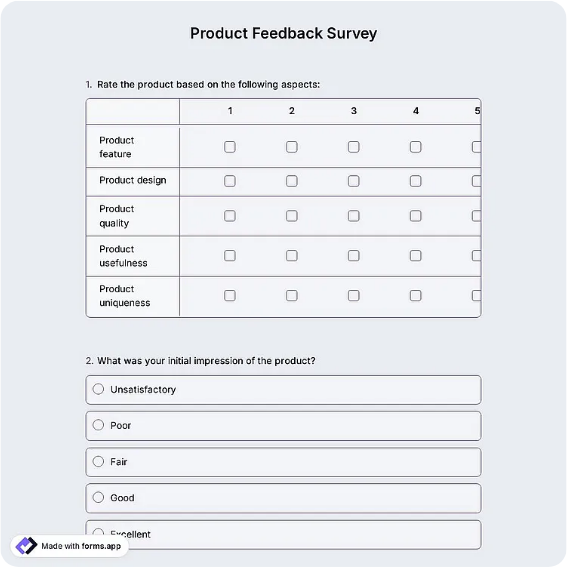
A Market Research Survey profiles how a target audience actually shops before you commit to a launch, a price, or a campaign. This template gathers light demographics (age range and location), then walks through buying habits: how often respondents purchase the product category, which brands they currently use, what matters most when choosing (price, quality, brand, or convenience), typical spend, and where they usually shop. It finishes with a 1-5 rating on willingness to try a new brand and an open question about what would convince them to switch.
Founders validating a product idea, marketing teams sizing a segment, students running coursework studies, and market-stall or e-commerce sellers testing demand all use this structure. The design principle is closed questions first: checkboxes and ranges produce answers you can segment and count, while the single open switching question captures the language real buyers use, which often ends up in your ad copy.
How teams use this form day to day
Fieldwork usually means intercepts: a clipboard stack of printed PDFs at a market, mall, or event where your audience already gathers, aiming for a target count like 100 completed sheets. Remote research runs through the online link shared in communities, newsletters, or paid panels. Either way, responses get coded into a spreadsheet with one column per question so you can filter, for example, weekly buyers under 35 who shop online.
Seasoned researchers decide the cross-tabs before collecting: knowing you will compare spend by shopping channel tells you whether your answer ranges are granular enough, and it stops you from discovering gaps after the clipboards come back.
Customize fields and branding
In the Word download, replace the decision-factor checkboxes with the drivers that matter in your category, for example sustainability, ingredients, or delivery speed for consumer goods. Adjust spend brackets to plausible amounts for your product; a $10-25 range is useless for furniture. Add a screening question at the top, such as "Have you bought this product type in the last 6 months?", when you only want answers from active buyers, and keep the survey unbranded if brand recognition would bias answers.
Common mistakes to avoid
Leading questions are the cardinal sin. "How much do you love the convenience of home delivery?" manufactures the result you wanted rather than measuring anything. Sampling only your existing customers is nearly as bad; they already chose you, so they cannot tell you why others do not. And keep age brackets tight enough to be useful, since an 18-45 bucket hides exactly the generational differences most launches hinge on.
Example scenario
A beverage startup surveys 120 shoppers over two weekends at a farmers market before committing to production. The founders expected price to dominate, but convenience and where-you-shop answers reveal most target buyers grab drinks at gyms and convenience stores, not markets. They redesign the packaging for cooler-shelf visibility and pitch gym chains first, an entirely different go-to-market than planned.
Choosing PDF, Word, or online
Match format to fieldwork. The printable PDF is made for intercept surveys where you approach people directly and clipboards beat QR codes. The Word file is your editing master for tailoring categories, brands, and spend ranges per study. The online links open a hosted version that scales past a few hundred responses effortlessly and exports straight to a spreadsheet. Serious studies often mix both, using paper at events and the link online, then merging the data.
Typical fields
- Age range
- Location / region
- How often do you buy this type of product?
- Which brands do you currently use?
- What matters most when choosing? (price / quality / brand / convenience)
- How much do you typically spend?
- Where do you usually shop?
- How likely are you to try a new brand? (1-5)
- What would convince you to switch?
Best for
- Pre-launch product validation
- Pricing and spend research
- Student and academic studies
- Local market demand testing
When to use PDF vs online
Use the PDF or Word download for in-person sign-ups, fax, or email attachments. Choose an online form when you need automatic notifications, payment integrations, or a shareable link for customers.